
AUDIO PODCAST OPTION FOR MY ARTICLE: “WHAT TO WATCH WHILE WEATHERING THE WUHAN”
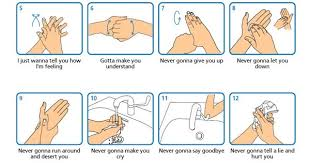
BEFORE WE START – GO WASH YOUR HANDS!!!
Then – I offer you two thoughts.
#1 Whenever faced with an anxiety provoking situation I ask myself: What’s the worse thing that could happen? The answer usually does not warrant my initial visceral knee jerk to whatever the problem at hand is, and it makes me realize I’m overreacting. In short – I tend to be a worry wart and freak out if I let my emotions get the better of me.
#2 Disaster movies are great fun for a number of reasons. (READ Cataclysm as Marital Therapy). But the most relevant reason for this article is: perspective. Having to grit your teeth through another boring meeting at work seems like a paid holiday if you remember you don’t have genocidal aliens hovering in mile wide spaceships over your building waiting for the right moment to incinerate you (“Time’s up” Independence Day). Dealing with a flat tire isn’t so bad when you note you can do it while making all the noise you want without fear of attracting killer monsters (A Quiet Place). Watching a disaster movie can help one embrace the philosophy: “I felt sorry for myself because I had no shoes until I met a man who had no feet.”
So given these two thoughts and while we’re all being denied: church services, sporting events, movie theaters, parties, festivals, and hugs, I give you:
FOUR MOVIES TO WATCH WHILE WILING AWAY THE WEEKS WAITING TO WEATHER THE WUHAN
THE ANDROMEDA STRAIN (1971)
One of my all time favorites. Understated and steeped in extrapolated current science fact, the story, based on the book by Michael Crichton, revolves around, not action heroes, but scientists at the top of their fields who tackle an unknown disease which turns blood to powder in moments. Arthur Hill is Dr. Jeremy Stone, expert bacteriologist and government attache who knows of certain hidden agendas. David Wayne is Charles Dutton, pragmatic and old school pathologist who always reminded me of Dr. McCoy. Kate Reid is Ruth Leavitt, curmudgeonly microbiologist with a secret that could endanger the team’s progress. James Olson is James Hall, slightly geeky surgeon, who you could easily believe spent a lot of his teen years playing Dungeons and Dragons. These people were no one’s idea of Avengers but worked as a team against time and an extraterrestrial virus which could cause global cataclysm.
Compared to The Andromeda Strain, the Wuhan is a wimp.
CONTAGION (2011)
Talk about jumping off today’s headlines! Contagion is a movie by Steven Soderburgh whose structure is much like Paul Haggis’ Crash! with multiple storylines woven, like a crocheted serviette, around a central issue which come together to form a whole picture. This movie is chock a block with familiar faces: Matt Damon (Bourne “fill in blank with a variety of nouns”, Good Will Hunting), Kate Winslet (Titanic, Hamlet), Gwenyth Paltrow (in so many Marvel movies with Robert Downey, Jr.’s Iron Man they finally broke down and gave her her own suit, Sliding Doors), Elliot Gould (M*A*S*H, Oceans’ 11, 12, 13, and 8), Jude Law (Fantastic Beasts, Captain Marvel), Laurence Fishburne (Othello, Matrix), Marion Cottillard (Nine, MacBeth), Bryan Cranston (Breaking Bad, Argo), Chin Han (Dark Knight, 2012).
Paltrow is patient zero of a pandemic which has jumped animal DNA from bat to human to become a brain eating, lung congester which kills pretty much every victim we see within 2 days of showing the first flu-like symptoms.
Compared to the bug in Contagion, the Wuhan is a wussy. 
OUTBREAK (1995 )
In one of the more formulaic thrillers, we have: the legendary Dustin Hoffman of MANY classic movies (Midnight Cowboy, Little Big Man, Finding Neverland, Tootsie, Rain Man, The Graduate, Marathon Man, Lenny, Papillon, Hero … *whew*), Rene Russo (Lethal Weapon), the disgraced Kevin Spacey, Cuba “Show me the money!” Gooding, Jr. (Jerry Maguire), Donald Sutherland (with a list of 194 credits he’s been in everything from the slapstick Start the Revolution Without Me to Pride and Prejudice), and the ubiquitous Morgan Freeman (Batman, Shawshank Redemption, Bruce Almighty) all struggle to contain an Ebola-like virus which originated in an African jungle, but, through a series of mishaps, infects the town of Cedar Creek, CA. Our intrepid heroes are hampered in their effort to find a cure by forces which want to retrieve the virus so they can turn it into a bioweapon and incinerate the infected town, ostensibly to prevent its spread, but in truth to hide their nefarious plans.
Compared to the buggie in Outbreak, the Wuhan is a weakling, with the added fillip that no one is planning to nuke any towns to get rid of it.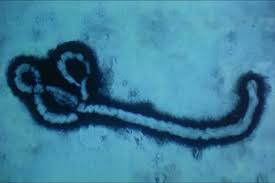
THE STAND (1994)
Done as a miniseries, the book was far better BUT, like Contagion, there is a legion of distinguished standards of both large and small screens as well as theater who ensemble their way through this 6 hour and one minute marathon. Look them up on us.imdb.com and enjoy some of these classic actors’ iconic roles: Gary Sinise (Forrest Gump, Apollo 13), Molly Ringwald (The Breakfast Club, Pretty in Pink), Jamey Sheridan (Sully), Lara San Giacomo (Pretty Woman), the multi-talented stage and film legend Ruby Dee (The Jackie Robinson Story, Raisin in the Sun), another legend Ossie Davis (one of the kings of 1950’s and 1960’s American TV shows from Car 54 Where are You? to Night Gallery, plus films ranging from Do the Right Thing to Grumpy Old Men), Matt (Max Headroom) Frewer, Rob Lowe (The Orville, Saint Elmo’s Fire), Ray (My Favorite Martian) Walston, Ed Harris (The Rock, A Beautiful Mind), Kathy Bates (The Blind Side, Richard Jewell).
The Stand also has a unique twist – after the plague has swept through the world and humanity’s remnants are just starting to put their lives and a fledgling new civilization back together, God and the Devil begin a competition for their souls.
The source book, especially, presents a surprisingly complex and extensive examination of extreme medical phenomena, societal structures, theology, and the internal and external struggles every man faces in choosing between good and evil.
The miniseries begins with an Apocalypse level virus, nicknamed Captain Trips, which wipes out 999 out of every thousand people around the world. In the aftermath, the survivors become the unwilling soldiers in a battle between Hell, represented by Randall Flagg, who sets up shop, appropriately in Las Vegas, NV, and God, represented by Mother Abigail Freemantle, who leads her flock to Boulder, Colorado.
Although the acting is not of uniform quality, many of these veteran character performers, like Sinise, Dee and Davis, shine above the awkwardly truncated story and pedestrian technicals. The soundtrack, by the gifted and prolific Snuffy Walden, has a charming midwestern Americana feel.
The movie even occasionally uses homages to classic literature such as Of Mice and Men.
Compared to Captain Trips, not only is the Wuhan a walk in the park, it’s a stroll you can take without the incarnation of the Devil himself chasing you in cowboy boots.
So — while you’re quarantined with no: sports, festivals, parties, restaurants, wedding receptions, theater events, movie popcorn, concerts, church fairs, handshakes, confirmations, church services, communal bowls of M&Ms, bridge nights, dances, sci fi conventions, bake sales, open air markets, live opera, or hugs – turn out the lights, choose one of these cathartic gems, confront your worst fears and … count your blessings.
AND WHILE YOU’RE AT IT — GO WASH YOUR HANDS!



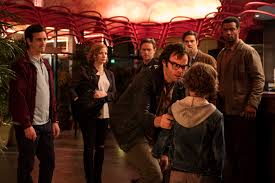


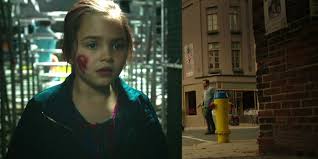
 Popular wisdom says that origin books are almost always better than the movies based on them. While often true the reverse is more prevalent than you might think.
 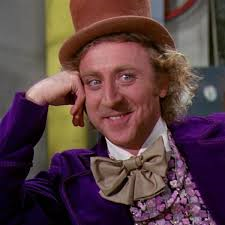 Take Gene Wilder’s Willie Wonka and The Chocolate Factory. The movie, based on the book Charlie and the Chocolate Factory, did not wander far from the source material. Though since Dahl wrote both the book and the first draft of the screenplay that is not surprising. But the movie had an added fillip which, to me, was the most memorable moment in the story. Charlie had snuck a sip of Fizzy Lifting Drink and Wonka tells Charlie because of that he won’t get any reward. But it’s a test.
 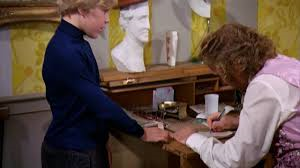 Despite Wonka’s cruel and angry behavior to him Charlie gives Wonka back the gobstopper souvenir instead of selling it to Wonka’s competitor. Wonka says: "So shines a good deed in a weary world," then tells Charlie he is to inherit the entire factory. It’s a beautiful moment masterfully played out between Wilder and Ostrum. But it wasn’t in the book. To me it was the crown jewel of the adventure.
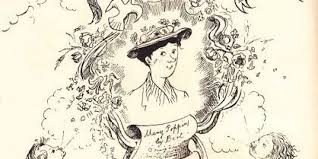 Mary Poppins was a series of adventures with the title character coming and going into and out of the Banks' children's lives, as the winds changed: trips around the world, tea parties on the ceiling, learning to cook when the Banks’ cook goes on leave, the birth of other children in the Banks' household, etc – some knit into the movie, most not. But no where does it have the central theme of rescuing not the children, but ultimately the Banks’ children’s father, despite the fact, according to the movie
 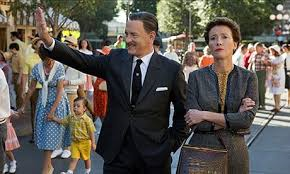 Saving Mr. Banks, this was the intent of her stories. Apparently she was just too coy with the theme. The movie, however, makes this beautiful theme crystal clear.
 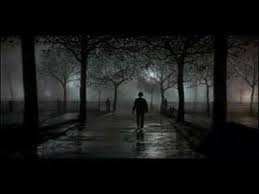 The hair on the back of your neck will stand up and the hardest will get teary watching a defeated Mr. Banks, knowing he is about to be fired, believing he has failed his children, stand, in the dark at the bottom of the steps of St Paul’s Cathedral where the children had wanted to buy feed for the birds. As the instrumental version of Feed the Birds swells in the background and you know there is a change of wind coming for HIM, you know you are experiencing one of the great moments of cinema. This was not nor could have been adequately portrayed in the book.
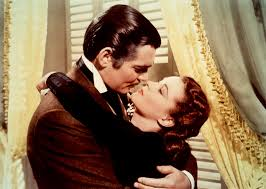 Gone With the Wind, while a classic book did not capture the imagination the way the movie did with its sweeping panoramas of Tara in her glory and stricken Confederate soldiers at the railroad station or the burning of Atlanta all against Max Steiner’s magnificent soundtrack and the incendiary chemistry between Leigh and Gable as Scarlett and Rhett played out in Technicolor.
 Harry Potter series, which are based on a sequence of books so packed with rich magical ideas and creativity that even in 8 movies the filmmakers could only make a Reader’s Digest version. Short shrift was given to some characters like
 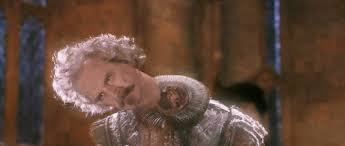 Nearly Headless Nick and some were left out altogether
 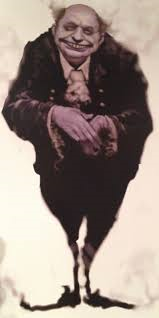 like Peeves; and some brilliant parts of the books were sadly absent from the films: Harry dressing down Lupin for virtually abandoning his wife and child; the previously misjudged Fleur Delacour declaring her continued devotion to the now scarred Bill Weasley saying "I am beautiful enough for the both of us." It was obvious the movies were a labor of love but just couldn’t do the books justice.
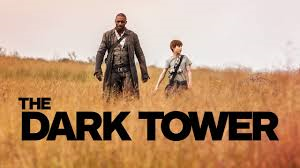
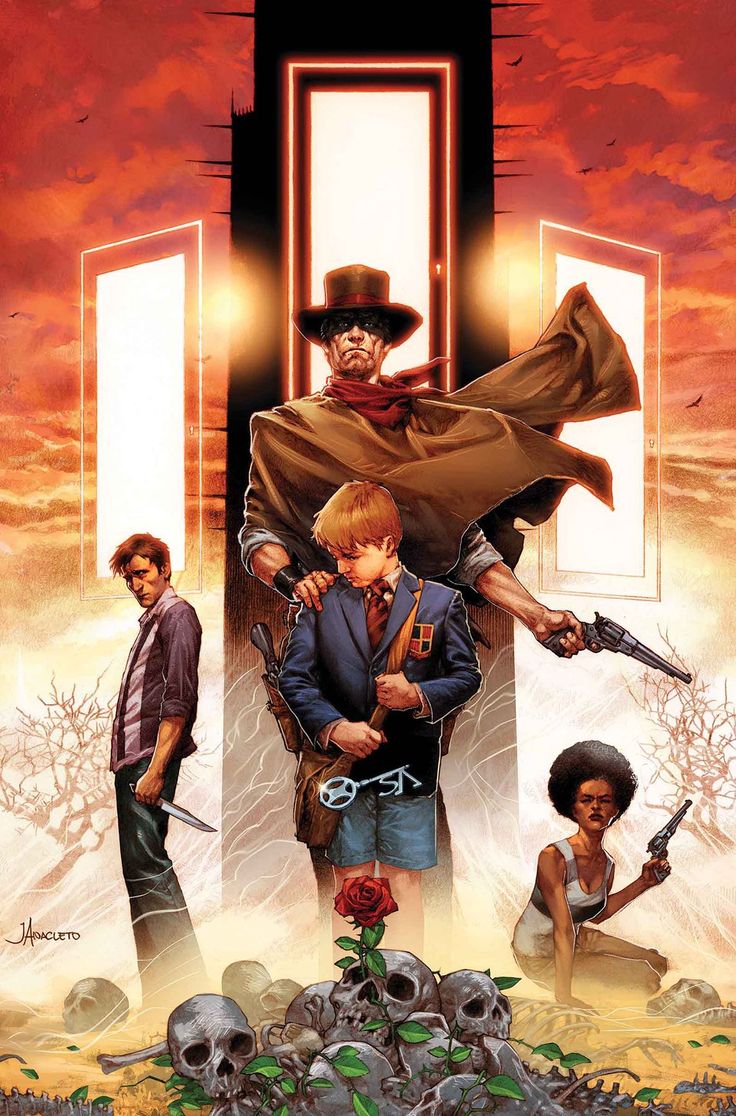 Then there’s Dark Tower. *weary sigh* I once was a fan of Stephen King. That was before he went on a diatribe against the pro-life movement, but that’s a story for another blog. During the height of my King fan-reading I tried to slog through the series of Dark Tower books AS they were coming out. I couldn’t get past the third of what would eventually be eight. It was an incomprehensible mess. It seemed as though King would wake up every morning and before his first cup of coffee spill, without filter, whatever thoughts came to him. Then the next day he would do the same thing, making weak efforts to tie what he’d written the previous day into the current days "work". There were lobster monsters and vampires, slow mutants and doomed theme parks, fatal rides on mining cars and homages to his other books. And in the book ROLAND, THE GUNSLINGER THOUGHTLESSLY MURDERS JAKE just to be able to continue his quest towards this Dark Man who, as time goes on, seems to not be quite as bad as the the Gunslinger himself. Then at the end of the 8th book (I read the Wikipedia synopsis recently as I didn’t want to wade through the rest of the books) King pretty much gives a middle finger to his audience, leaving the Gunslinger to start his quest all over again with no real resolution. The series reads like a challenge to see just how devoted his fans really are – like an insecure child constantly misbehaving just to be forgiven, demanding his parents prove they love him.
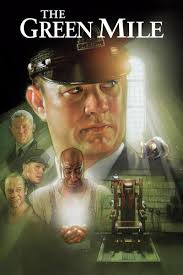 Green Mile was a beautifully written modern parable and I’d be hard pressed to say which I liked better – book or movie. They were both well done, the former by King the latter by Frank Darabont.
 So they took the general idea of the Dark Tower quest, the 3 main characters – Roland, Jake and Walter the Dark Man, SOME of the weirdness
  (animal mutants wearing people faces) and created a STORY.
 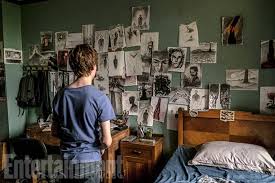 Fatherless Jake and his widowed then remarried mother live in a New York beset with signs of coming cataclysm – earthquakes and eerie storms. His visions of the gunslinger’s Wasteland – a world which has "moved on" – and his violent outbursts drive his desperate mother to seek help from psychiatrists who ultimately schedule him for a stay at a retreat for troubled youths. When Jake realizes the social workers who have come to take him are mutants from the Wasteland of his visions he escapes through a portal in an abandoned house possessed by a demon sent by the Dark Man….and THIS is the version of the story that makes SENSE!
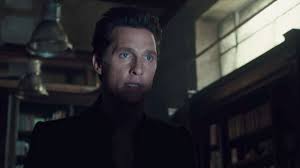 The Dark Man, Walter, is played like a sinister Vegas magician by Matthew "Interstellar" McConaughey. Not his fault – just the way it’s written. McConaughey does his best to tread that fine line between over the top scene chewing bad guy and seductive Hannibal Lector-like serial killer. The result is serviceable but nothing to write home about.
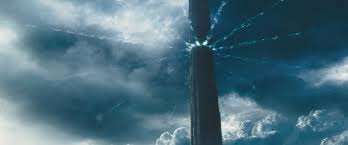 If the Dark Tower is the force for good, why is it DARK? The thing looks pretty darned creepy as portrayed – not some bastion of good and cohesive force. Traditionally, especially in a mythos-like fable of good and evil something this DARK would represent evil. And why is something DARK under attack from the DARK Man? The name similarities are either a product of a direct intentional relationship or sloppy writing. If the former there is a glaring inconsistency. As this is a completely invented universe we have no context for making a distinction and are given no explanation. Where did the mutants come from and why does the Dark Man make them wear masks? Why do the "mutants" look like large versions of Ratty from Wind in the Willows? How did the Wasteland come to "move on" and where did that expression come from? Not to be pedantic or facitious but where did it move to? Just an odd phrase for something falling apart. How does the Gunslinger have the power to resist the Dark Man’s magic and if the Dark man has the power to put people under his control just by waving at them why does he play with Roland like a sated cat with a mouse instead of just sending people by the thousands to overwhelm him?